
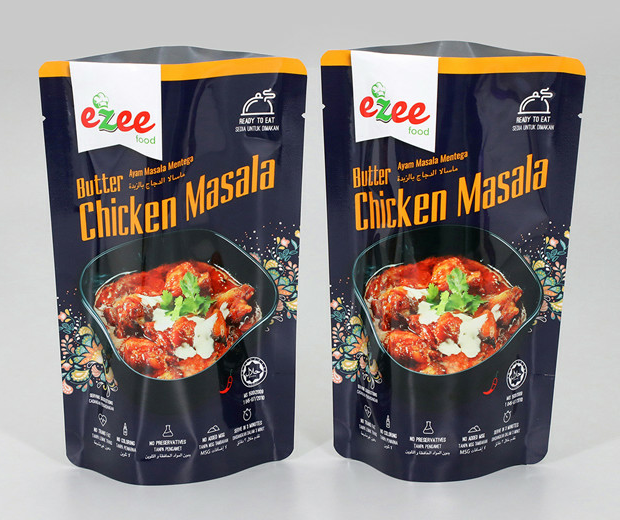
In the flexible packaging industry, retort pouches are widely used in food, ready-to-eat meals, beverages, and other fields due to their excellent barrier properties and high-temperature resistance. Based on a standard quotation sheet, this article analyzes key technical parameters and customization requirements to help you better understand product specifications and selection.
I. Product Specifications
The quotation sheet lists two common specifications for retort pouches:
| Item | Width | Length | Bottom | Thickness | Material Structure | Printing | Special Requirement |
|---|---|---|---|---|---|---|---|
| 1 | 115mm | 180mm | 80mm | – | NY/AL/RCPP / PET/AL/NY/RCPP / NY/PET/RCPP | 8-color printing | Retort resistant |
| 2 | 200mm | 300mm | – | 130micron | Same as above | 8-color printing | Retort resistant |
Note: Overall thickness ranges from 100–130 micron or 150–200 micron, depending on structure.
II. Material Structure Interpretation
Common material combinations for retort pouches include:
NY/AL/RCPP: Nylon/Aluminum/Retort-grade CPP, offering excellent oxygen and moisture barrier properties, suitable for high-temperature sterilization.
PET/AL/NY/RCPP: Polyester/Aluminum/Nylon/Retort-grade CPP, providing higher strength, ideal for heavy packaging.
NY/PET/RCPP: Aluminum-free structure, suitable for applications requiring metal detection, while maintaining certain barrier properties.
These multi-layer structures are produced through lamination processes to ensure the pouches do not rupture or delaminate during high-temperature retorting.
III. Printing and Customization Requirements
Printing Process: Supports 8-color printing, enabling high-precision, high-saturation图案 presentation to enhance brand recognition.
Special Requirements: All pouches must be “retort resistant,” suitable for high-temperature sterilization treatments above 121°C.
IV. Selection Recommendations
For heavy contents or long-term storage, it is recommended to choose aluminum foil-containing structures (e.g., PET/AL/NY/RCPP) for stronger barrier properties.
For products requiring metal detection, aluminum-free structures (e.g., NY/PET/RCPP) can be selected.
Thickness selection should be based on the nature of the contents and sterilization method: generally, 100–130 micron is suitable for lightweight foods, while 150–200 micron is appropriate for products with bones or sharp contents.


